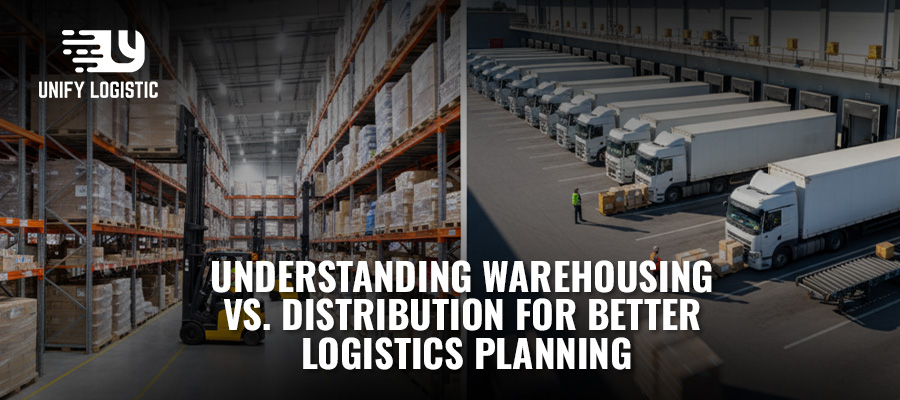
Over the last few years, many businesses have come to realize the importance of the supply chain and how it transforms their business model. For example, during the pandemic, both small retailers and global brands experienced shipping delays. This makes them pay more attention to how their products are being stored and transferred.
Warehousing and distribution are two essential parts of the supply chains that keep the whole system running. Even though they sound similar, they actually do completely different jobs.
As your business grows, understanding the difference becomes very important because they both take up a huge part of your operational budget.
Warehousing mainly focuses on storing and managing your goods, while distribution is all about getting those goods delivered to the people who need them, and the demand for both is only increasing. So, let’s break everything down in the simplest way possible
Warehousing: Where Everything Starts
Warehousing is like a commercial space that connects production to distribution within the supply chain and supports inventory management. Its primary function is to store, track, and dispatch goods when they are needed. These could be raw materials waiting to be used or finished products waiting to be sold.
If you’re running a business, you might use different types of warehouses depending on what you sell. Let's look at some of the types of warehousing available in the industry.
- Cross-dock warehouses: These warehouses do not really “store” a lot of goods. Most of the time, products come in on one truck and almost immediately leave on another. It is a great option for a very short period of time.
- Seasonal warehouses: A great option for products that are only sold at specific times of the year.
- Refrigerated warehouses: They are used for storing sensitive goods and products that require a specific temperature, such as food, medicine, flowers, and many more.
Distribution: Getting Things Moving
Distribution is the part of the supply chain that makes sure your goods reach their final destination (a store, a wholesaler, or a customer ordering online from their couch). A big part of distribution happens inside distribution centers, often run by 3PL (third-party logistics) companies. These companies are responsible for picking, packing, sorting, and shipping customers' orders.
Let's look at some of the different types of distribution centers available based on the technology used:
- Conventional centers: Mostly manual work.
- Mechanized centers: Use conveyors and sorting machines.
- Automated centers: Robots are responsible for doing most of the heavy lifting.
Why Warehousing & Distribution is Important for a Smooth Supply Chain
When you look at how products move from a factory to the people who buy them, two things matter more than most people realize: where the items are stored, and how they are delivered. That’s basically what warehousing and distribution are. They are not the most enticing parts of the supply chain, but they are the ones that keep everything from falling apart.
You can’t have good distribution logistics without good warehousing, and warehouse logistics isn’t very useful if things aren’t shipped properly. They depend on each other. When both are handled well, the whole supply chain feels steady and predictable. Orders get picked faster; deliveries are on time, and businesses save a lot of money by avoiding mistakes and delays.
The Advantages of Warehousing and Distribution Logistics
Keeps Everything Organized
A warehouse is a place where products are stored safely, sorted, and found easily. When a business has proper storage, it avoids a lot of common problems, such as running out of stock, having many damaged items, slow order processing, and poor inventory management.
A good warehousing means:
- Products are stored in the right conditions
- Items are easy to locate when orders come in
- Stock levels are accurate
- Goods don’t get lost or mixed up
Ensure Products Get Where They Need to Go
Once products leave the warehouse, distribution takes the lead. This includes everything from packing orders and planning delivery routes to ensuring items reach the final customers or stores on time.
A strong distribution system does the following:
- Reduces delays
- Cuts down transportation mistakes
- Makes deliveries faster
- Keeps customers satisfied
Good distribution also helps companies save money because they’re not constantly fixing shipping errors or paying for last-minute deliveries.
Better Customer Service
When warehousing is organized, and distribution runs smoothly, customers benefit from the smooth process. Their orders arrive on time; items are in good condition, and they get exactly what they paid for. In a world where people expect quick delivery, this matters more than ever.
Lower Costs Over Time
Although warehousing and distribution require planning and investment, operating them saves many companies from losing a lot of money over time. This is because they help them avoid waste, reduce product damage, prevent stock shortages, and cut transportation costs by being more organized.
In Conclusion
Warehousing and distribution may not be the flashiest parts of the supply chain, but they’re the reason products move smoothly from one point to another. When these two areas work well, everything else in the supply chain feels easier and more organized.
At Unify Logistic Solutions, we aim to provide the best freight carriers for businesses that want to move their cargo anywhere across the United States and Canada.
Are you ready to get started with getting your business back on track? Contact us here today for a quote and increase your business success!