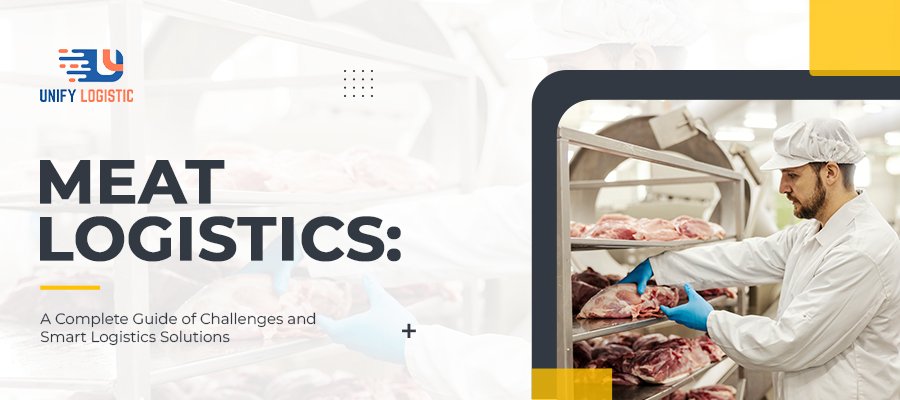
Moving meat from a processing facility to a retailer, restaurant, or export market is one of the most demanding jobs in food supply chain management. The product is perishable, the safety standards are strict, the documentation requirements are detailed, and the consequences of getting any part of it wrong go well beyond a delayed delivery.
Meat logistic operations sit at the intersection of cold chain management, regulatory compliance, and precision transport, and every link in that chain has to hold.
In this blog, Unify Logistic Solutions explains the real challenges businesses face when moving meat and what it takes to solve them.
What Does Meat Logistics Involve?
Meat logistics is the process of getting meat products from slaughter or processing through storage, transport, and distribution to the end buyer, which can be a supermarket chain, a food service operator, or an export market overseas.
What makes it different from moving other freight is the product itself. Meat begins deteriorating from the moment it is processed. Temperature, hygiene, handling, and timing are the differences between a product that reaches the customer in good condition and one that does not make it at all.
Why Does Temperature Control the Most Important Factor?
The cold chain is the temperature-controlled steps that carry meat from processing to the point of sale. Every link in that chain has to be held to avoid spoilage.
The meat must be transported in refrigerated vehicles at a stabilized temperature with systems able to avoid sharp variations during the journey.
Meat transportation requires the right equipment, properly maintained refrigeration units, and a monitoring system that detects problems in real time.
Some of the temperature requirements include the following:
- Fresh beef: Between 0°C and 4°C consistently throughout storage and transport
- Frozen meat: Below -18°C without fluctuation
What Are the Biggest Challenges in Meat Logistics?
Maintaining the Right Temperature
Maintaining the proper temperature throughout all stages of the operation is the challenge that sits behind everything else in meat logistics. Having good refrigeration at the warehouse while your carriers does not affect the meat. It is not enough to have a reliable carrier if the cold rooms at the destination are not up to standard.
Every handoff in the chain is a vulnerability. Product moving from a chilled processing facility to a refrigerated truck, from the truck to a distribution center, and from there to the final delivery point.
Preventing Contamination at Every Stage
It is important to avoid cross-contamination and maintain constant hygienic conditions in meat logistics. Contamination does not always come from obvious sources. Poorly cleaned vehicles, inadequate separation of different meat types, and storage facilities that are not properly maintained create risk.
The equipment that handles meat cannot be shared with anything that could introduce contamination. Vehicles need to be cleaned and inspected between loads. Storage facilities need regular audits. The team handling the product needs to understand food safety at a practical, day-to-day level.
Managing Regulatory Compliance Across Markets
Complying with health standards and specific documentation is where businesses run into trouble when shipping across borders.
Domestic meat regulations are already detailed. From inspection records and health certificates to traceability of documentation and land labeling requirements.
International shipments add another layer. Every country has its import standards, documentation requirements, and inspection processes. Not following them can lead to fines or the rejection of the product.
For any business moving meat across borders, compliance has to be built into the operation from the start.
Covering Long Distances Without Losing Quality
Transporting meat long distances while maintaining the quality of the product is challenging without proper monitoring.
The longer a journey, the more opportunities there are for temperature fluctuations, mechanical failures, and delays. A shipment that takes hours needs different planning than one that takes three days. Routes need to be mapped with refrigeration infrastructure in mind. Contingency plans need to exist when things go wrong.
Reducing Losses from Equipment Failures and Delays
Reducing losses arising from failures in the refrigeration or delays requires preventive maintenance, contingency planning, and real-time monitoring working together.
A refrigeration unit that fails mid-journey is a serious problem because the entire meat may spoil. If there is a real-time temperature monitoring system in place and someone is watching the data, the problem can be caught early. A response can be organized, and the loss can potentially be prevented or minimized.
Delays create similar risks. Planning those delays with buffer time built into schedules, knowing where the pressure points in a route are, is what makes managing meat logistics operations achievable.
Providing Full Traceability
Providing full trackability is one of the most important parts of meat shipping. Retailers, food service operators, and export buyers want to know where the meat came from, how it was handled, and what conditions it travelled under.
When they ask for that information, businesses that have it readily available maintain the relationship. Those who cannot provide it lose trust and often lose account.
How Is Technology Changing Meat Logistics?
Advanced Logistics Management Systems
The system integrates information on transport, warehousing, orders, and quality indicators into a single environment. This enables real-time visualization of the operation.
When all of that information is in one place, the operation runs better. Decisions get made faster and with better information.
Smarter Refrigerated Vehicles
New models of refrigerated trucks and trailers have more robust refrigeration systems, lower energy consumption, and technologies that keep the temperature stable when shipping over long distances. This evolution contributes to reducing environmental impact and increases the reliability of the deliveries.
Data-Based Traceability
The use of digital platforms enables recording all the stages travelled by cargo, from the origin through to the destination. This trackability facilitates fast audits, checks for regulatory compliance, and offers greater transparency for clients and inspection bodies. In case of incidents, identification of the cause is immediate.
Why Dies Temperature-Controlled Warehousing Matter as Much as Transport?
A lot of businesses focus heavily on the transportation of meat logistics and underestimate what happens in the warehouse. Both matter equally.
After the initial transport from the cold warehouse to the distribution centers, the meat is stored in refrigerated or frozen rooms in warehousing centers.
Here, the temperature has to be maintained with precision, rigorous control, and frequent inspections. Clean, organized environments with low exposure to humidity help avoid contamination.
Good meat warehousing means:
- Refrigerated and frozen rooms that maintain precise temperatures consistently, not just most of the time
- Regular inspections and documented temperature logs
- Clean, well-maintained environments with controlled humidity
- Clear separation of different product types to prevent cross-contamination
- A management system that tracks every product from the moment it arrives to the moment it leaves
Practical Steps to Improve Your Meat Supply Chain
- Audit your cold chain from end to end: Do not only check the shipping process. Look at every loading dock, distribution center, receiving bay, and identify where temperature consistency is most at risk.
- Invest in real-time monitoring: Temperature sensors in vehicles and storage facilities that feed live data to someone who is watching make an enormous difference to how quickly problems get caught.
- Maintain your equipment properly: Refrigeration unit failures are largely preventable. Regular servicing and pre-trip inspections are compulsory.
- Get your documentation right: Know exactly what is required for every market you ship to and have a system that keeps those records accurate and accessible.
- Train your team: The best equipment and the best systems only work if the people operating them understand why food safety procedures exist in Logistic Solutions.
- Build contingency into your routes: Know where the delay risks are and plan for them rather than responding to them.
Why You Need to Choose Unify Logistics When Shipping Meat?
Meat logistics does not forgive shortcuts. A provider who handles general freight well is not automatically equipped to manage temperature-sensitive, highly regulated products that have to arrive in perfect condition every single time.
Unify Logistic works with businesses across the meat industry that need a logistics partner who understands cold chain management, compliance, and product integrity. Whether you are a processor moving product to domestic retailers, a distributor managing multiple delivery accounts, or a business shipping meat to export markets, we will design a process specific to your freight.
Unify Logistic Solutions delivers meat logistics solutions that cover the entire step (temperature-controlled warehousing, compliant transport, real-time monitoring, documentation management)