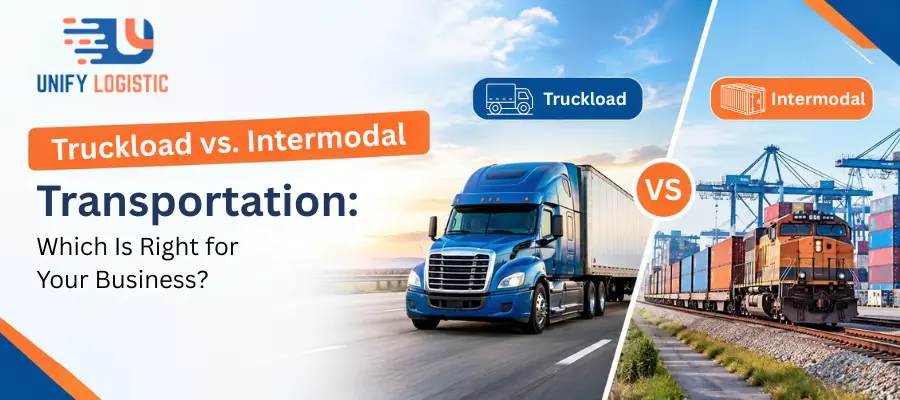
If you ship freight regularly, you would have come across questions like, "Do you want truckload or intermodal shipping?'' and wondered which one is perfect for your business.
Full truckload services are the process of using an entire truck to move your freight from pick-up to final delivery. Intermodal, on the other hand, works differently, moving freight between truck and rail partway through the trip. Although both shipping processes get your goods where they're going, the difference is the route.
When businesses pick the wrong shipping method. It slows down the delivery time, increases their cost, or wastes time they didn't need to lose. This is why it is important to sort out the best option for your freight before signing a contract.
What Does Truckload Shipping Look Like?
Truckload is when goods are loaded onto one truck, and that same truck carries them all the way to the destination. This means there is no vehicle swapping or stopping to pick up another freight at any point. Full truckload works best when you have enough volume to fill a trailer. This is because you will be paying for the whole truck, so you might as well use the space instead of shipping half a load.
What Does Intermodal Shipping Involve?
Intermodal is when a freight shipment starts on a truck, switches to rail for the long middle stretch, then is loaded back onto a truck for final delivery. The process often looks complicated because it requires more coordination and moving pieces, but it also saves money in the long run compared to other modes. Rail is often cheaper than trucks when shipping over distance. That's why intermodal is used specifically on cross-country hauls, where any cost saved is noticed.
How to Know When Truckload Is Clearly the Better Call
Truckload is often the best option when your freight needs to move fast. This is because there will be no freight transfers, which ensures fewer chances of delay.
It is also the better pick for freight that is time-sensitive, perishable, retail restocks, and goods that cannot afford an extra day or two delay. Truckload gives you a more predictable timeline, especially on shorter routes.
When is The Time to Use Intermodal Shipping?
The best time to opt for intermodal shipping is during long hauls, especially anything over 750 miles. The amount of money freight owners save on rail increases over that kind of distance, more than they would on a shorter regional.
Intermodal shipping also works well for freight that extra day or two of transit will not cause problems; it ends up becoming a smarter financial decision, especially bulk or non-perishable goods.
What If Your Freight Doesn't Fill a Whole Truck?
Not every shipment can fill an entire truckload, and that's exactly where less-than-truckload freight comes in. LTL shipping allows business owners to pay for the space they need to ship their freight in an entire trailer. This helps them save money and ensure their freight is delivered at the right time.
What Are the Costs of Truckload and Intermodal Shipping?
Truckload pricing is very simple and easy to budget because one rate covers the whole trip. Intermodal, on the other hand, looks cheaper in the beginning, especially on long hauls, but can have extra fees for rail yard handling or unexpected delays during the process.
That is why it is important to ask exactly what's included in an intermodal quote before assuming it's automatically the cheaper option.
What Is the Best Choice for Reliability and Timing?
Truckload shipments are more predictable, mostly because it is one continuous route with little to no room for surprises that affect your delivery timeframe.
Intermodal, on the other hand, has more variables, which include rail schedules, yard availability, and the handoff between truck and train. That doesn't make it unreliable, but more prone to delay than a truckload shipment.
How To Know the Best Option for Your Freight
The best way to know the perfect option for your freight depends on what you're shipping and how fast it needs to be delivered. If you are shipping time-sensitive freight, then truckload will be the right option. Intermodal shipping should be used for longer and less urgent shipments.
A lot of businesses often use both and switch depending on the shipment. The ability to do this saves more money and time than only sticking with one approach no matter your freight needs.
Unify Logistic helps businesses figure out which option fits each shipment, instead of using a one-size-fits-all approach. Our logistic solutions offer both truckload and intermodal shipping. Let's help you move your freight efficiently without thinking about the risk of delay.
Frequently Asked Questions
Intermodal is usually cheaper on longer routes because rail transportation can cost less than trucking. For shorter distances, truckload may be more cost-effective when you consider additional handling and transfer costs associated with intermodal shipping. Unify Logistic Solutions offers both options based on your freight needs.
Intermodal delivery times depend on the distance, route, and type of freight. It can take an additional day or two because of rail yard handling and truck-to-train transfers. For time-sensitive shipments, truckload may be a better choice because it generally provides more direct transportation.
Intermodal shipping is not necessarily less reliable than truckload, but it involves more transportation stages. Rail schedules, terminal handling, and transfers can introduce additional variables. Truckload offers more direct transportation and can be easier to predict, making it suitable for freight with strict delivery deadlines.
Small businesses can use truckload services without filling an entire trailer, but it may not always be the most cost-effective option. For smaller or occasional shipments, less-than-truckload (LTL) shipping can be more economical because businesses pay for the space their freight requires. Unify Logistic Solutions can help businesses choose the right option based on shipment size and requirements.
Truckload shipping is well suited for time-sensitive freight, perishable goods, retail restocking, and larger shipments where delivery speed is important. Because truckload shipments generally travel directly from pickup to delivery with fewer transfers, they can help reduce handling and potential delays.
Still have questions?
Contact Us