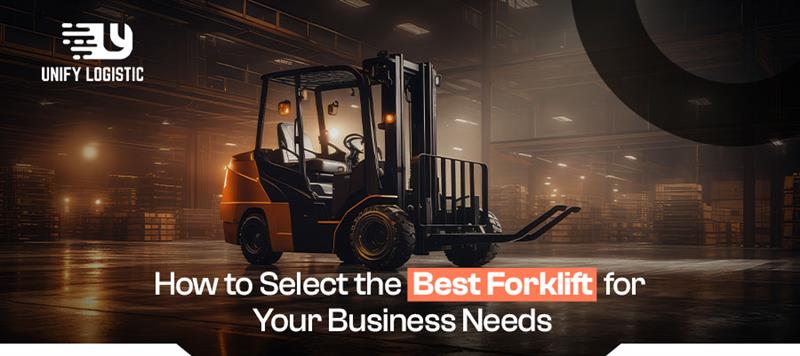
When mentioning equipment used in warehouses, shipping docks, and even small retail storage rooms, one tool that cannot be bypassed is the "Forklift". Although not flashy or commanding attention, without them, everything slows down, sometimes to a painful halt. However, choosing the right one can be challenging with many different types and models available in the market today.
The forklift you choose for your business must be able to perform at the utmost level to improve productivity, reduce manual labour and the risk of injury. Picking the wrong ones often leads to operational inefficiency, slower output and higher costs.
So, can you choose the right forklift the first time? Unify Logistic Solution is here to answer all your questions in this blog. After reading this blog, you will understand the intricacies of forklifts and what to look for when selecting yours. Let's break down everything and give you the answers you need.
What is The Meaning of Forklift
A forklift is a small industrial machine built to do a specific duty: lift and move heavy loads that humans find difficult to do on their own. It is designed to meet the needs of transporting materials and goods within warehouses and other larger storage systems across industries.
A forklift is a combination of a small truck and a lever system. It has two strong and long forks attached to the lift materials that look like giant metal prongs. The machine is used to transfer products and materials that are on a pallet or other platform. It operates by sliding its metal fork under bulky items and then using hydraulic power to lift them from one place to another.
Operating a forklift often requires proper training, understanding of each part and attention to detail to ensure smooth operation. A forklift needs power to function, and its source can be from fuel or a battery. After its engine starts working, the machine can be driven and lift those heavy loads.
The Different Types of Forklifts
Forklifts aren’t “one-size-fits-all,” as each one is designed for a specific purpose and environment. Here are some of the various types of forklifts used in industry.
Counterbalance Forklift
Counterbalance is a type of forklift with two forks at the front that slide under loads and a steel heavyweight at the back to keep it balanced. This ensures that heavier loads are easily lifted and dropped at any time. These forklifts are very useful, reliable, and designed for moving pallets from one place to another.
Reach Forklift
Reach trucks are designed to be used in places in aisles that are very narrow. The space is also very tight, and goods are stored high up. They act as a tall ladder on wheels, which allows workers to safely take or store products in places a normal forklift could not reach.
Pallet Jack
A pallet jack is often a manual or electric tool with tapering forks used for moving loads on the ground within short distances inside warehouses and other industrial settings.
Order Picker
An order picker is a type of electric forklift that is used for picking people's orders instead of entire pallets. This tool is perfect for warehouses that receive orders for online shopping companies, and they need to take items from different places within the aisle.
Rough Terrain Forklift
Also known as the 'off-road vehicles', this type of forklift family has large tires with deep treads and strong suspension, making them operate in outdoor areas. These include construction sites, farms, or muddy roads.
Side Loader
This forklift is designed to carry long, bulky items on the side, instead of the front. They are often used for carrying long, bulky materials such as timber, steel pipes, or large sheets of metal.
How to Choose the Right Forklift for Your Business: Key Factors to Consider
Understand Your Work Environment
The first thing to consider is where your forklift will be used. For example, is it indoors in a warehouse with smooth floors, or outdoors on rough terrain? The answer will determine the type of forklift you will choose. However, if you need a forklift for both indoor and outdoor operations, then buy the one that adapts to both environments.
Know Your Load Requirements
This is one area where many businesses make mistakes—underestimating or overestimating the forklift’s lifting capacity. For an estimated result, weigh the heaviest load you need to lift regularly and check the maximum storage height in your facility.
This is because a forklift designed to carry a load of 3,000 lbs. at ground level may not safely carry that same weight at higher lift heights. When you choose a forklift with the right capacity, it ensures safety, efficiency, and prevents wear and tear on the equipment.
Think About Space
All forklifts are specifically designed for different kinds of spaces. For example, a reach truck or narrow aisle forklift is great for narrow aisles while a counterbalance forklift is perfect for a more wider environment. Therefore, it is important to choose the one that will work perfectly for your space.
Choose the Right Power Source
The source of your forklift power often affects both your operating costs and maintenance. Here’s a simple breakdown:
- Electric forklifts: Best for indoor use, environmentally friendly, lower operating costs, but require charging downtime and battery maintenance.
- Diesel forklifts: Powerful, reliable outdoors, good for heavy loads, but noisy and produce emissions.
- LPG (propane) forklifts: Flexible for both indoors and outdoors, quick to refuel, but slightly higher fuel costs.
When making your final decision, think about your long-term budget, fuel access, and whether emissions could be a problem in your facility.
Maintenance and Support
The forklift is a long-term investment and needs maintenance to keep it in optimum performance. So, ensure the manufacturer provides a guarantee and maintenance services
In Conclusion
Choosing the best forklift makes your operation seamless and relieves the stress of picking and loading heavy weights within your warehouse. And when you get it right, the forklift improves productivity, keeps your workers safe, and saves your business money in the long run.
Unify Logistic Solution provides a network of forklift services for businesses. Our team of expert professionals ensure your shipping is seamless and delivered of the highest quality. We offer solutions that overcome every industrial challenge.
Frequently Asked Questions
The three key questions that clear up most of the confusion are; what space does it have, what load does it lift, and on which surface is it operating. Good indoor floors favor electric forklifts while outdoor rough terrain favors larger tires and sturdier construction. Narrow aisles call for reach trucks. Overestimating capacity can cost more than the forklift over its lifetime.
Mostly by removing the friction nobody talks about until it's happening daily. Equipment that can't reach the right shelf height. Machines too wide for the aisle they're supposed to work in. Hydraulics straining under loads they weren't rated for. When the forklift actually fits the environment it's working in, loading and unloading stops being the part of the day everyone dreads.
More than people assume, and in ways that catch operations off guard. A forklift's rated capacity changes at height; what it safely lifts at ground level isn't what it safely lifts elevated. Unify Logistics Solutions matches forklift capacity to real freight requirements, so nothing gets overloaded, tipped, or damaged mid-operation because someone trusted a ground-level spec for an elevated task.
No direct emissions during operation, which matters for indoor air quality; more than most facilities acknowledge until someone measures it. Running costs over time sit lower than diesel or propane alternatives. The honest tradeoff is charging time; batteries need downtime built into shift schedules, or the efficiency gains disappear quickly. Worth the planning if indoor sustainability targets are real rather than just stated.
Slowly in some places, significantly faster in others. Automated guided vehicles handle repetitive fixed-route tasks reliably; same pallet, same path, high volume. Human operators still handle the unpredictable parts... variable loads, dock work, anything requiring judgment a sensor can't replicate yet. The honest picture is partnership rather than replacement, at least for most warehouse environments operating today.
Still have questions?
Contact Us