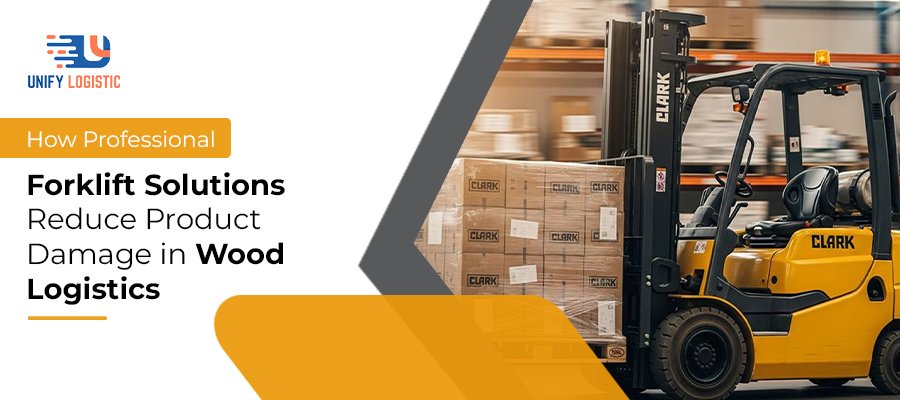
The wood and timber industry runs on products in their best shape and condition. Damaged wood, timber, or lumber affects more than a supply chain; it affects the business financially. From something as small as a scratch to breakage, cracking, and instability, damaged woods lead to rejected shipments and unhappy customers.
Handling wood is complex because it can be heavy and bulky. Maneuvering wood requires the right equipment so that it can be protected from damage. Professional fork lift services can help businesses prevent wood damage during handling. They ensure safety and efficiency, helping organizations improve their lumber logistics operations.
Read the full blog to dive deeper into how forklift solutions can reduce product damage in wood logistics.
How Does Product Damage Occur During Wood Handling?
Every wood product is made up of different materials and has different characteristics. Finished wood gets scratched or dented easily, and plywood gets damaged if it is not supported properly. Long and heavy timber beams are very difficult to transport from one spot to another. The reason behind damages is mostly caused by improper handling.
The main reason behind damages is choosing the wrong or faulty forklift. Using a wrong-sized, worn-out, or bent forklift can cause unstable loads, slipping, and damage. As a result, logistics operations slow down while there is constant worry about damaging products and increasing safety risks.
The Need to Choose the Right Forklift for Lumber
Preventing lumber starts with choosing a forklift meant for specific requirements. A forklift that is designed to handle the material that you want to move from place to another. Standard forks may not always provide the support or precision needed for wood products.
For illustration, tapered lumber forks slide between layers more smoothly, helping reduce splintering when lifting bundled materials. Wide forks provide greater surface support for plywood and MDF, helping reduce bowing and instability. Anti-slip forks improve grip when handling smooth or damp lumber.
Selecting equipment based on specific requirements acts as an effective logistic solution for handling multiple types of wood products.
Improving Stability During Transportation
Lumber stability during transportation is necessary to prevent product damage. Unstable loads may shift during transit and can fall or collide if not repositioned on time. So, the operator has to stop and rearrange lumber for stability before continuing. It increases handling time and affects the supply chain.
A properly configured forklift provides better load control from pickup to final placement. Specialized attachments, side shifters, clamps, and other equipment can improve maneuverability and help operators position awkward or oversized loads more precisely. Forklifts are also used throughout forestry and lumber operations for transporting raw timber, moving processed lumber, stacking inventory, and loading finished products.
Better stability means fewer unnecessary movements and less contact between the forklift and the product.
Matching Equipment to the Working Environment
Wood logistics does not take place in a single type of facility. Operations may include sawmills, warehouses, lumber yards, loading docks, and outdoor storage areas. Each environment presents different handling challenges.
Outdoor lumber yards may have uneven, muddy, or sloped surfaces. In these conditions, rough-terrain forklifts with suitable tires, ground clearance, and stability features can provide better performance. Indoor warehouses, on the other hand, may require equipment designed for narrow aisles and controlled maneuvering. Side loaders can be particularly useful for moving long timber through confined spaces.
Selecting equipment according to the environment helps prevent sudden movements, unstable loads, and collisions that can contribute to product damage.
Regular Maintenance Protects Products
Even the right forklift can cause damage if it is poorly maintained. Forks should be inspected regularly for wear, bends, cracks, damaged locking mechanisms, and rough or sharp surfaces. Excessive fork wear can reduce capacity, while damaged edges can mark finished wood products. Burwell Material Handling recommends incorporating fork condition checks into pre-shift inspections and preventive maintenance programs.
Maintenance should also cover tires, hydraulics, chains, brakes, mast components, and attachments. Keeping these components in good condition allows operators to make smoother movements and maintain better control over loads.
For businesses without the internal resources to manage all these requirements, professional fork lift services can provide valuable support through inspection, maintenance, equipment selection, and operational guidance.
Operator Training Makes a Difference
Technology and equipment alone cannot eliminate product damage. Operators need to understand how different wood products should be picked up, transported, stacked, and placed.
Training should cover load capacity, load-center considerations, fork positioning, attachment limitations, safe travel speeds, and appropriate stacking techniques. Operators should also understand how to recognize damaged forks and other equipment issues before beginning a shift.
When trained operators work with correctly specified equipment, businesses can reduce unnecessary repositioning, improve load stability, and create more consistent handling practices.
How to Build More Efficient Lumber Logistics Operation
If you want to reduce product damage, you must understand the entire handling process. It means you must review any recent damage incidents, detect the reason behind them, examine the forklift, check the load size, and find out if the equipment is appropriate or not.
By combining all possible scenarios and situations, businesses can create an efficient strategy. You can improve loading efficiency and prevent damage incidents by changing the forklift.
Building more efficient lumber logistics operations is not easy, and that’s why professional fork lift services are a hassle-free solution. They help transform material handling from a potential source of product loss into a competitive advantage. From selecting equipment to specialized forks, preventive maintenance, and trained operators, logistics solutions improve productivity.
How Unify Logistic Solutions Can Help
Making sure your wood handling is done without any disruptions is not limited to buying a forklift. Businesses need a solution that combines the entire logistics workflow while maintaining safety.
Unify Logistic Solutions focuses on offering practical approaches that can support your wood logistics requirements. We coordinate freight through a network of carriers and provide customized transportation solutions for different industry requirements. If you are looking for forklift services, we offer experienced freight brokerage solutions for your transportation needs. Our team chooses the right forklift, reduces avoidable damage, and keeps your lumber loads moving. With carrier coordination, freight management, and shipment visibility, we help businesses move their goods efficiently.